Showing posts with label Teaching and Learning. Show all posts

Friday, September 23, 2011

Sketchbook sample images

More on sketchbooks. Check out these drawings which feature Chris Priestley's detailed studies of people and some architectural drawings from several sources.

Your work can be graphic, detailed or impressionistic but it must be honest and it has to be made on a daily basis. Whatever format of sketchbook you use keep it with you at all times so you are able to respond to external stimuli.

Karl


Images © Chris Priestley


Tuesday, September 06, 2011

LCC Round About 2011 film of student works

Check this out Jack!

THE POWER OF MAKING at the V&A

Get yourself down to the V&A sucker.

6 September 2011–2 January 2012

The Porter Gallery
Room 48
Admission free

The V&A and Crafts Council celebrate the role of making in our lives by presenting an eclectic selection of over 100 exquisitely crafted objects, ranging from a life-size crochet bear to a ceramic eye patch, a fine metal flute to dry stone walling. Power of Making is a cabinet of curiosities showing works by both amateurs and leading makers from around the world to present a snapshot of making in our time.

The exhibition showcases works made using a diverse range of skills and explores how materials can be used in imaginative and spectacular ways, whether for medical innovation, entertainment, social networking or artistic endeavour.

Making is the most powerful way that we solve problems, express ideas and shape our world. What and how we make defines who we are, and communicates who we want to be.

For many people, making is critical for survival. For others, it is a chosen vocation: a way of thinking, inventing and innovating. And for some it is simply a delight to be able to shape a material and say ‘I made that’. The power of making is that it fulfills each of these human needs and desires.

Those whose craft and ingenuity reach the very highest levels can create amazing things. But making is something everyone can do. The knowledge of how to make – both everyday objects and highly-skilled creations – is one of humanity’s most precious resources.

Guest Curator, Daniel Charny


Thursday, July 28, 2011

MA in Illustration @ Camberwell College of Art London

I have been offered a place on the MA in Illustration at Camberwell. I'm really excited about this but know I have a lot of work to do. The course starts in October but I'm using my annual leave in August to start working on my research project.

'100 DATES' will become a reality. Check out my Happy Accident - World of Graphic Storytelling Blog for updates on this project.

Karl

Wednesday, May 04, 2011

FdA Design for Graphic Communication Year 1

Workshop 3 Rules: The Architecture of lines

A geometric line used as a graphic enhancement in page assembly - the term
is used to distinguish ruling lines from a line of type. A line can be used to
represent almost any idea that a designer can conceive.

In this workshop you will use the power of line to express your understanding
of 3D structure by exploiting the materials supplied.

You are to work in teams of 6. Decide who will be responsible for what in your
team. Make notes and record the development of your design work. You will
gain interpretive skills and a greater awareness of London as a specific
location and how this can be communicated to an audience. Use the following
brief to help you to design a new landmark and then construct a 3D model of
your design.

‘We decided we needed something extra, something to distinguish
the…London skyline, something to arouse the curiosity and wonder of
Londoners and visitors’.
Mayor of London, Boris Johnson, 2010

Design a new iconic landmark for London to act as a major and permanent
visitor attraction. Londoners can enjoy a ‘must see’ destination, which will help
to regenerate London.

Karl Foster 3 May 2011


Wednesday, March 02, 2011

Friday, February 25, 2011

10 Lessons for young designers


Saw this on one of my students blogs thought I'd share it with you.

Thanks Carlo.

Karl

These are some insightful and thought-provoking lessons from Wieden+Kennedy’s Executive Creative Director, John C Jay:
10 Lessons for young designers.

1: Be authentic. The most powerful asset you have is your individuality, what makes you unique. It’s time to stop listening to others on what you should do.

2: Work harder than anyone else and you will always benefit from the effort.

3: Get off the computer and connect with real people and culture. Life is visceral.

4: Constantly improve your craft. Make things with your hands. Innovation in thinking is not enough.

5: Travel as much as you can. It is a humbling and inspiring experience to learn just how much you don’t know.

6: Being original is still king, especially in this tech-driven, group-grope world.

7: Try not to work for stupid people or you’ll soon become one of them.

8: Instinct and intuition are all-powerful. Learn to trust them.

9: The Golden Rule actually works. Do good.

10: If all else fails, No. 2 is the greatest competitive advantage of any career.

Friday, February 11, 2011

FdA Design for Graphic Communication Year 1 & 2

DITTO PRESS

The Brief:

Ditto Press is a print/publishing company based in London. We are looking for a new publication that shows off the capabilities of our printer in an innovative and interesting way. The final product will need to reflect our aesthetic and make full use of our machines potential.

We print with a two-colour Riso machine and stock 12 colours. We are looking to produce a small publication that addresses a range of issues:

- The way the ink sits on different papers
- Legibility with different fonts
- Overlapping different colours
- Different photographic rasterisation effects
- Gradient effects
- Anything else you can think of

The final product will carry a selection of test prints designed by a range of students. Each student is required to submit a novel idea for binding the publication, which we expect to be between 5 and 10 test prints.

We are extremely particular about the standard and quality of anything we publish so you will need to pay attention to detail, be original and really investigate the print process. Having said that, we are expecting a simple and clear solution from each student. The final selection will entirely depend on the quality of the submissions, i.e. if there is only one good submission we will only print that one, but if there are more we will set a limit based on practicalities.

Important times and dates:
- Briefing: 10th Jan, Ditto Press Studio, 10am
- Interim Critique: 28th Jan, LCC, time tbc
- Final Presentation: 11th Feb, LCC, all day

Formative Assessment Schedule Critique:
You will be expected to have your work ready for 10.30am, 11th February, 2011.

Below are examples of the work produced by 12 of students who took part in this project.

Well done guys, keep up the good work.

Karl

Wednesday, February 02, 2011

FdA Design for Graphic Communication Year 1 & 2

Ditto Press Assignment

The students had little visual information to show but with a major crit surgery ahead I should be able to capture the design solutions for this assignment. Look out for that post.

In the meantime have a look at the work produced by Katia Kuvshinnikova for the exercise set out below.

Exercise 1
Using you digital camera or mobile phone capture a minimum of 10 images of the environment of LCC. Before you decide on what to photograph consider the following compositional factors first:

Extreme angles

Strong diagonals

Natural and artificial Grids

Cropping

Contrasting materials

Close-up detail

Reflective surfaces

Exercise 2
Select 5 of your photographs then download them to the College computer and make a B/W A4 size print of each.

Using the tracing paper provided on each photograph locate all the cones, cubes and spheres within them.


All work © 2011 Katia Kuvshinnikova

FdA Graphic Spatial Communication Year 1

Exhibition Design Assignment

Working in groups the students on this course are tasked with creating an exhibition experience aimed at Undergraduate students like themselves. The exhibition space (images below) is very large and a challenging prospect for any would be exhibition designer. Good luck with the assignment guys you've got what it takes to produce something wonderful.

Karl


Brief

The project explores the idea of LCC organising an exhibition by students for students to help them understand story-based art forms. The exhibition would be located in the New Gallery within the Workshop block of the college. Teams of students would be selected to produce proposals for the design of the exhibition in terms of narrative, layout, displays and graphics.

Working in teams (3 students per team) you are to design an exhibition using one the exhibition titles below as a starting point:

• Film Noir – The Long Goodbye
• Manga and Anime – A Rising in the East
• Street Art – From Basquiat to Banksy

The exhibition should be educational and help students discover more about you chosen subject in a way that is entertaining, enlightening and meaningful. You will have to research the chosen subject in great detail.

Know the space: you will need to survey and record features of the space and produce a plan, elevations and photographs to use as the basis for all your drawings and models.

Know your subject: gather all information with regards to your chosen subject and write your exhibition brief and narrative.

The project should take into consideration basic health and safety and accessibility requirements.

You will also need to explain how sustainability is at the heart of your designs and source samples of the materials you will be using:
You will need to consider assembly (can it be taken apart with minimal damage and re-use), are you using local suppliers or at least UK materials to minimise transport, chose non-toxic/ chemical free alternatives, biodegradable alternatives and renewable timber if used.


Wednesday, January 19, 2011

FdA Design for Graphic Communication Years 1 & 2

Ditto Press Assignment

Here are some examples of the work created by students on Tuesday 18 January as part of their attempts to generate information to solve the problem set by our Work Based Learning contact Ditto Press.

Thanks to the students for letting me display their work.

They worked from the workshop brief set out below.

More next week.

Karl

Mountains from Molehills - Pattern via Data

More and more information is being visualised. Diagrams, data and information graphics are utilised wherever increasingly complex elements are present, whether it is in magazines, non-fiction books or business reports, packages or exhibition designs. Today, diagrams are being applied beyond their classical fields of use. In addition to archetypical diagrams such as pie charts and histograms, there are manifold types of diagrams developed for use in distinct cases and categories. These range from chart-like diagrams such as bar, plot, line diagrams and spider charts, graph-based diagrams including line, matrix, process flow, and molecular diagrams to extremely complex three-dimensional diagrams. The more concrete the variables, the more aesthetically elaborate the graphics – sometimes reaching the point of art – the more abstract, the simpler the readability.

Briefing:
You will be working in groups today to solve the problems set. Everyone must make an effort to contribute to the three Exercises. Remember to photograph the results of this assignment for your records.

Exercise 1
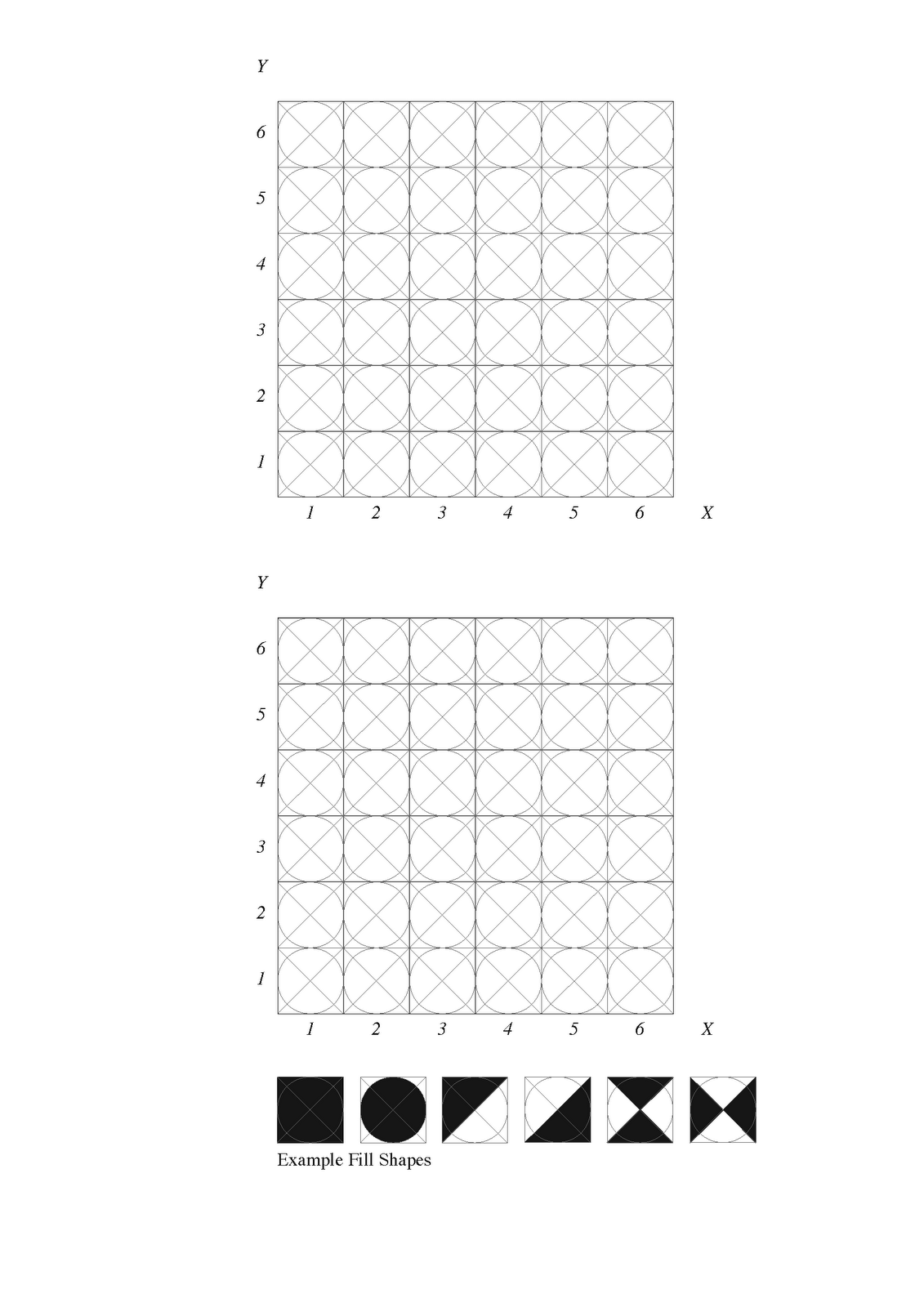
You are required to create a minimum of 6 Tile designs using random Data Use the worksheet and dice supplied to generate these designs.

To find the square on the on the grid sheet that you should fill in first roll dice A to get the X co-ordinate then roll dice B to get the Y co-ordinate. Continue like this until you have filled a total of 12 of the 24 squares on each grid. This means you should roll each dice 12 times. You need to repeat this action 5 more times to get your minimum 6 Tile designs. Each tile should look individual.

Please note the examples of the Fill shape you can place in the selected squares of the grid. You can adapt this if you wish.

Exercise 2
You now have 6 Tile designs. Looking at worksheet 2 use the 6 Tile designs to help you present the Data given in each of three examples in a visually interesting manner.

Please note there maybe some mathematical inconsistencies in the Data when you add it up. What could be the reason for this?

Exercise 3
The Ditto Press are looking for ideas and well as striking images that show the potential of the Risograph process. Select one of the examples from Exercise 2 and develop this further into a more sophisticated graphic solution.

Click on the two images below for greater detail.


Thursday, January 13, 2011

FdA Design for Graphic Communication Year 1 & 2

Ditto Press Assignment - Sourcing Pattern Workshop

Here are some examples of the work created by students on Tuesday 11 January as part of their attempts to generate information to solve the problem set by our Work Based Learning contact Ditto Press.

Thanks to the students for letting me display their work.

They worked from the workshop brief set out below.

More next week.

Karl


Tuesday 11 January 2011

Sourcing Patterns

Only he who has a different visual opening can see the world in another way and can pass on to his neighbour the information required to broaden his field of view...let us get used to looking at the world through the eyes of others.
Bruno Munari

Exercise 1
Using the image supplied by your tutor make tracings from it of shapes you find interesting. You need to produce a least five separate tracings showing your analysis of the images complexity.

Select your two most successful tracings and recreate them using the black and white paper supplied. Select one of your black and white images and invert it.

Exercise 2
Using the sheet supplied by your tutor create five separate tessellated patterns. Suggested words to help you with the pattern construction process:

Cutting, Folding, Interlocking, Repetition, Symmetrical, Asymmetrical

Photograph the results of this assignment for your records.

Links to extend your knowledge:

Bruno Munari inspired website
http://www.munart.org/index.php?p3=2

PORTFOLIO MICHIEL SCHUURMAN
http://www.michielschuurman.nl/search/label/Portfolio

GABRE° Gabriel Andermatt
http://www.gabre.ch/index.php?/projects/halbtonstimulationen/

Exercise 1. (La Pedrera by Antoni Gaudi)

Exercise 2 (Tessellation Source)

Friday, December 31, 2010

2011

It's time to take advantage of the opportunities set out before you. Recognise your path and equip yourself for the journey ahead. Greatness never comes from only dreaming, you have to make it happen.

Let's see what's out there...

Thursday, July 01, 2010

New Student work FdA Design for Graphic Communication

As promised here are some examples of student Final Major Project work for the FdA Design for Graphic Communication course.

The students had to produce an A5 research book containing their vision of London through the eyes of a designer. The images show how the research books were displayed during the end of year show.

Karl
Monday, June 21, 2010

New Work FdA Graphic Spatial Communication

As promised here are some examples of student Final Major Project work for the new FdA Graphic Spatial Communication course.

The students are working on ideas for a Branding project and have chosen The Early Learning Centre (ELC) flagship store revamp or MTV headquarters new coffee bar.

Karl

Wednesday, May 05, 2010

New Student work FdA Design for Graphic Communication

The 1st year students on the FdA Design for Graphic Communication are working on a major project to produce a research book that shows London through the eyes of a designer.

I have designed four workshops that students can sign up to and so far they are proving successful.

My workshops are called:

Symbol and Diagram

Communication and Texture

Scale Part1

Scale Part 2

Students have been exploring the many facets of London its hidden systems, wayfinding systems, emphasizing status through scale and selection using the 21 senses.

The students will use the workshops as inspiration for the chapters of their London research book.

I will be uploading examples of their work over the next few weeks.

Karl